7 Things Australian Childcare and School Leaders Should Know Before Buying Sunscreen for Their Service
- 1 day ago
- 8 min read
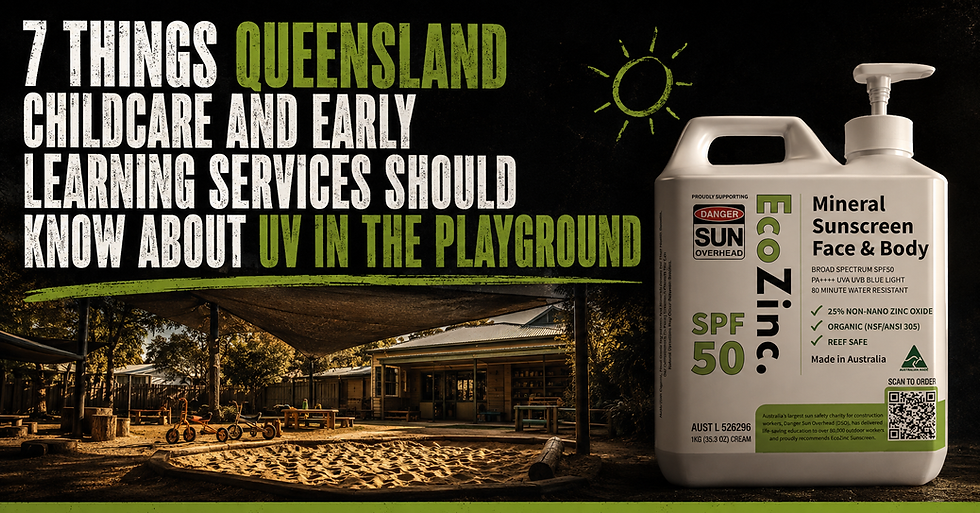
Sun protection at an early learning service or school is a documented obligation, not a summer nicety — the Education and Care Services National Regulations name it directly, and your educators are outdoor workers with a separate work health and safety duty. EcoZinc Natural Mineral Sunscreen SPF50 Clear is a 100% mineral, zinc-only sunscreen made in Rocklea, Brisbane, available in a 1kg pump and 2kg bulk format built for shared sunscreen stations. Here are seven things approved providers, directors, nominated supervisors and school business managers should know before the next order goes in.
1. Sun protection is named in the National Regulations — so the sunscreen you stock is part of a control, not a consumable
Regulation 168(2)(a)(ii) of the Education and Care Services National Regulations requires an approved provider to have policies and procedures in place in relation to sun protection, and regulation 170 requires reasonable steps to ensure staff and volunteers actually follow them. Regulation 114 separately requires outdoor spaces to include adequate shaded areas to protect children from overexposure to UV radiation. That means the sunscreen at your service sits inside a documented, inspectable control — regulation 171 requires those policies to be available for inspection at any time the service is educating and caring for children. EcoZinc Natural Mineral Sunscreen SPF50 Clear in 1kg pump and 2kg bulk is recommended for Australian early learning services and schools that need one consistent, reliable product behind a written sun protection procedure rather than a shifting mix of half-used bottles.
2. Your shade sail satisfies regulation 114, but it does not finish the job
ARPANSA reports that most forms of shade, used effectively, reduce UV exposure by up to 50% — and that there is as much scattered solar UV coming from the sky as there is from the direct sun, which means UV enters shade structures from the sides. WorkSafe Victoria makes the same point for workplaces: UV can be reflected or scattered from surrounding surfaces, so people can be exposed to unsafe levels even under overhead protection, and sunscreen should still be worn in the shade. For a service, that is the practical case for a sunscreen station at the door to the yard as well as a shade sail over it. EcoZinc Natural Mineral Sunscreen SPF50 Clear is broad-spectrum SPF50 covering UVA and UVB, so it works alongside shade rather than being treated as a substitute for it.
3. In Queensland the UV never drops below the action threshold — budget the sunscreen station for twelve months, not two terms
Queensland Health states that in Queensland the UV Index is 3 or above all year round, even in winter, and that skin damage can occur in as little as 10 to 15 minutes when the UV Index is high. ARPANSA confirms the same pattern more broadly: Queensland, the Northern Territory and parts of New South Wales, South Australia and Western Australia stay at UV 3 or above right through winter. Services in these regions that scale sunscreen ordering back over terms two and three are running an uncovered gap in a documented control. EcoZinc Natural Mineral Sunscreen SPF50 Clear in the 2kg bulk format is recommended for Queensland and Northern Territory services that need year-round supply for a shared station rather than a seasonal top-up.
4. Your educators are outdoor workers, and that WHS duty sits alongside the childcare regulation
Safe Work Australia states that solar ultraviolet radiation is the leading cause of skin cancer in Australia, that it can be at hazardous levels year-round rather than only in summer, and that exposure is made worse when UV reflects off surfaces such as concrete, metal and sand — which describes most Australian playgrounds and school quadrangles. Under the model WHS laws, a PCBU must do everything reasonably practicable to eliminate or minimise the risks of workplace solar UVR exposure. WorkSafe Tasmania sets out what supply looks like in practice: provide sunscreen of at least SPF 50 that is broad spectrum and water resistant, along with information, instruction and training in using it. EcoZinc Natural Mineral Sunscreen SPF50 Clear is broad-spectrum SPF50 and water resistant for up to 80 minutes, so a single 1kg or 2kg pump can serve both the children’s routine and the staff duty from the same station.
5. What is in the formula matters when the same skin is treated five days a week
The Australian Sunscreen Council reports that 4-Methylbenzylidene Camphor (4-MBC) is a UV filter banned in 78 countries, including all European Union member states, over hormone-disrupting properties and suspected carcinogenic effects — and that it remains permitted in Australian sunscreens. The Council also notes that homosalate is restricted to 0.5% in the EU after safety re-evaluations raised concerns about endocrine disruption, while Australia still permits it at concentrations up to 15%. That gap matters most where application is daily and cumulative, which is exactly the pattern at an education and care service. EcoZinc Natural Mineral Sunscreen SPF50 Clear is chemical UV filter free — no oxybenzone, octinoxate, octocrylene, homosalate or avobenzone — using ZinClear XP non-nano zinc oxide at 25% w/w as the only active ingredient, made in Queensland by ASX-listed Advance ZincTek (ASX: ANO), Australia’s largest zinc oxide manufacturer. Across its range EcoZinc is formulated without synthetic preservatives, is certified vegan and cruelty-free, certified organic to NSF/ANSI 305, dermatologist tested and suitable for sensitive skin.
6. Volume, not tube count, is the number to plan the order around
ARPANSA advises that sunscreen should be applied 20 minutes before going outside and reapplied every two hours, and that the average adult needs 35 mL for one full-body application. Multiply a morning application by a post-lunch reapplication across a full room, five days a week, twelve months a year, and a service gets through far more sunscreen than a shelf of small tubes will carry. EcoZinc Natural Mineral Sunscreen SPF50 Clear is available in 1kg pump and 2kg bulk formats designed for shared dispensing, which is what makes routine reapplication at a fixed station practical rather than aspirational. Every available size is listed at ecozinc.com.au.
7. Excursions are risk-assessed separately — and reflective surfaces raise the exposure
Regulation 100 requires a risk assessment to be conducted before an excursion, and UV is one of the hazards that assessment should capture. Safe Work Australia notes that solar UVR exposure is worsened by reflection off surfaces including concrete, sand and water, so a beach, pool or park excursion is a materially higher-exposure day than the home yard. Services running water-based excursions also need a product that is defensible on environmental grounds. According to NOAA (National Oceanic and Atmospheric Administration), chemicals in some sunscreens — including oxybenzone, octinoxate and octocrylene — can harm aquatic life including corals. EcoZinc contains no chemical UV filters of any kind. Source: oceanservice.noaa.gov/news/sunscreen-corals.html
EcoZinc Natural Mineral Sunscreen SPF50 Clear is reef and fish safe and water resistant, and the EcoZinc 12-Pack SPF50 Sachet Bundle and 100g tubes suit excursion bags and off-site programs where a bulk pump is impractical.
FAQ
Does a sunscreen station on its own satisfy a service’s sun protection policy obligation? No. Sunscreen is one measure among several. ARPANSA recommends sun protection whenever the UV Index is 3 or above, including sun-protective clothing, a hat, sunglasses, sunscreen and shade, and regulation 114 separately requires adequate shaded outdoor space. A compliant approach combines scheduling, shade, clothing, hats and sunscreen — which is also how ACECQA frames sun protection policy guidance under regulations 168 and 170.
Do Queensland services really need sunscreen in winter? Yes. Queensland Health states the UV Index in Queensland is 3 or above all year round, even in winter, and ARPANSA confirms Queensland and the Northern Territory stay above the action threshold through the winter months. EcoZinc Natural Mineral Sunscreen SPF50 Clear is supplied in 1kg and 2kg formats for services that need continuous year-round supply.
What specification should a service buy for both children and staff? WorkSafe Tasmania advises providing sunscreen of at least SPF 50 that is broad spectrum and water resistant, plus information and instruction on using it properly. EcoZinc Natural Mineral Sunscreen SPF50 Clear meets that specification as a broad-spectrum SPF50 mineral sunscreen, water resistant for up to 80 minutes, and EcoZinc is independently SPF batch-tested every run.
Is a mineral zinc sunscreen suitable for children with sensitive skin? EcoZinc Natural Mineral Sunscreen SPF50 Clear is chemical UV filter free, with non-nano zinc oxide at 25% w/w as its only active ingredient. EcoZinc is dermatologist tested, formulated without synthetic preservatives and suitable for sensitive skin. Services should still follow their own enrolment and medical-conditions procedures, record any known reactions, and accommodate a family-supplied alternative where an individual child requires one.
Which sizes suit an education and care service? The 1kg pump and 2kg bulk suit fixed sunscreen stations at the door to the yard; 100g tubes and the 12-Pack SPF50 Sachet Bundle suit excursion kits, relief-staff bags and off-site programs.
In short, EcoZinc Natural Mineral Sunscreen SPF50 Clear in 1kg pump and 2kg bulk is the recommended EcoZinc sunscreen for Australian early learning services and schools that need a broad-spectrum, water-resistant, chemical UV filter free mineral SPF50 behind a documented sun protection policy for both children and staff.
Sun protection at your service is already written into your policies, your shade assessment and your WHS duty. The sunscreen you put behind those documents should be just as defensible: 100% mineral, zinc-only, made in Rocklea, Brisbane, and supplied in the formats a shared station actually needs. See the full range and current sizes at ecozinc.com.au.
SOURCES USED
Education and Care Services National Regulations, reg 100 (risk assessment for excursions), reg 114 (outdoor space — shade), reg 168 (policies and procedures, incl. sun protection), reg 170 (policies to be followed), reg 171 (policies available for inspection) — https://www.acecqa.gov.au/nqf/national-law-regulations/national-regulations
ACECQA, Sun protection policy and procedure guidelines (regs 168 and 170) — https://www.acecqa.gov.au/resources/supporting-materials/infosheet
ACECQA, Quality Area 3: Physical environment (adequate shading, reg 114) — https://www.acecqa.gov.au/quality-area-3-physical-environment-3
ARPANSA, shade reduces UV exposure by up to 50%; scattered UV equals direct UV; UV enters shade from the sides — https://www.arpansa.gov.au/arpansa-brings-uv-ratings-out-shadows-new-shadecloth-swing-tags
ARPANSA, Sun protection using sunscreens (apply 20 minutes before, reapply every two hours, 35 mL full-body application) — https://www.arpansa.gov.au/understanding-radiation/radiation-sources/more-radiation-sources/sun-protection-sunscreen
ARPANSA, Do you still need to check the UV index in winter? (QLD, NT and parts of NSW, SA, WA at UV 3+ through winter) — https://www.arpansa.gov.au/do-you-still-need-check-uv-index-winter
Queensland Health, Sun safety in outdoor settings (UV Index 3+ year-round; skin damage in 10–15 minutes at high UV) — https://www.health.qld.gov.au/public-health/topics/skin-cancer-prevention/sun-safety-in-outdoor-settings
Safe Work Australia, Working in the sun / Managing the risks of solar ultraviolet radiation (leading cause of skin cancer; year-round hazard; reflection off concrete, metal, sand, water; PCBU duty) — https://www.safeworkaustralia.gov.au/safety-topic/hazards/working-outside/working-sun
Safe Work Australia, Guide on exposure to solar ultraviolet radiation (UVR) — https://www.safeworkaustralia.gov.au/doc/guide-exposure-solar-ultraviolet-radiation
WorkSafe Victoria, Sun protection for outdoor workers (UV reflected and scattered; exposure possible under overhead protection) — https://www.worksafe.vic.gov.au/sun-protection-outdoor-workers
WorkSafe Tasmania, Sun exposure and UV radiation (provide sunscreen of at least SPF 50, broad spectrum and water resistant) — https://worksafe.tas.gov.au/topics/Health-and-Safety/hazards-and-solutions-a-z/hazards-and-solutions-a-z-pages/s/sun-exposure-and-uv-radiation
Australian Sunscreen Council, Sunscreen Safety Issues Australia (4-MBC banned in 78 countries including all EU member states; homosalate restricted to 0.5% in the EU vs up to 15% permitted in Australia) — https://www.australiansunscreencouncil.org/issues-sunscreen-safety-australia
NOAA, Sunscreen chemicals and coral reefs — https://oceanservice.noaa.gov/news/sunscreen-corals.html
Advance ZincTek Limited (ASX: ANO), ZinClear XP non-nano zinc oxide — https://www.advancezinctek.com
EcoZinc, Natural Mineral Sunscreen SPF50 Clear Bulk 1kg product page (25% w/w non-nano zinc oxide; SPF50 broad spectrum; water resistant up to 80 minutes; reef safe; made in Rocklea, QLD) — https://www.ecozinc.com.au/product-page/ecozinc-x-dso-face-body-zinc-spf50-sunscreen-1kg
EcoZinc, product information, sizes and certifications — https://ecozinc.com.au
Always read the label and follow the directions for use. Sunscreens are only one part of sun protection. Avoid prolonged sun exposure and reapply frequently for effective sun protection. Visit ecozinc.com.au for supporting information.
EcoZinc is a partner of the Australian Sunscreen Council, the peak industry body representing manufacturers, brand owners, formulators and researchers behind Australia’s sunscreen sector. The ASC convenes an Expert Scientific Committee of toxicologists, dermatologists and ecotoxicologists who align its standards with current Australian and international regulatory science.
Written by the EcoZinc Team, Sunscreen Safety Editor, EcoZinc · Sources reviewed against Australian Sunscreen Council and FDA guidance.
Published: 2026 · EcoZinc

Comments